Wednesday, December 19, 2007

Can IBM Connect Cores In a Chip With Light?

Can IBM Connect Cores In a Chip With Light?

IBM has come up with a technology that could one day let different cores on a processor exchange signals with pulses of light, rather than electrons, a change that could lead to faster and far more energy efficient chips.

The device, known as a silicon Mach-Zehnder electro-optic modulator--converts electrical signals into pulses of light. The trick is that IBM's modulator is 100 or more times smaller than other small modulators produced by other labs. Eventually, IBM hopes the modulator could be integrated into chips.

Here's how it works. Electric pulses, the yellow dots, hit the modulator, which is also being hit with a constant beam of light from a laser. The modulator emits light pulses to correspond to the electrical pulses. In a sense, the modulator is substituting photons for electrons.

Since the beginning of the decade, several companies--Intel, Primarion, Luxtera, IBM--have been coming up with components that, ideally, will let chip designers replace wires in computers and ultimately chips with optical fiber. Wires radiate heat, a big problem, and the signals don't travel as fast as light pulses. (The research in this area is known as silicon photonics and optoelectronics.)

AddThis Social Bookmark Button

Light-powered Toothbrush Could Eliminate Need For Toothpaste

Light-powered Toothbrush Could Eliminate Need For Toothpaste

The Shiken Company of Japan is making a prototype solar-powered toothbrush, which causes a chemical reaction in your mouth, with the hopes of improving the elimination of harmful plaque and bacteria.

Dr. Komiyama designed the first model of this type of toothbrush more than 15 years ago: It contained a titanium dioxide rod in the neck of the brush, just below the nylon bristles. Any light falling on the wet rod would release electrons, which would react to the acid typically found in the mouth, helping break down plaque.

The latest model, the Soladey-J3X, works in much in the same way, except that it's twice as powerful.

The brush also has a solar panel at the base, which transmits electrons to the top of the toothbrush through a wire.

AddThis Social Bookmark Button

Researchers Identify Granddaddy Of Human Blood Cells

Researchers identify granddaddy of human blood cells

Researchers at the Stanford University School of Medicine have isolated a human blood cell that represents the great-grandparent of all the cells of the blood, a finding that could lead to new treatments for blood cancers and other blood diseases.

This cell, called the multipotent progenitor, is the first offspring of the much-studied blood-forming stem cell that resides in the bone marrow and gives rise to all cells of the blood. It's also the cell that's thought to give rise to acute myelogenous leukemia when mutated.

Isolating this cell, which is well known in mice but had yet to be isolated in human blood, fills in an important gap in the human blood cell family tree. The work is published in the Dec. 13 issue of the journal Cell Stem Cell.

Irving Weissman, MD, director of Stanford's Institute for Stem Cell Biology and Regenerative Medicine, spent his early career identifying each cell in the mouse blood family tree. The progression went from the stem cell through the progenitor cell through progressively more specialized cells, ending up with the red blood cells, platelets and immune cells that make up the bulk of the blood.

This detailed information has helped researchers understand the origins of blood diseases and cancers and has led to advances in bone marrow transplantation. But studies in mice are never a perfect substitute for understanding those same cells in humans, said Ravindra Majeti, MD, PhD, an instructor in hematology and co-lead author of the paper.

AddThis Social Bookmark Button

Super Water Repellent Could Cause Big Wave In Market

Super Water Repellent Could Cause Big Wave In Market

A water repellent developed by researchers at the Department of Energy's Oak Ridge National Laboratory outperforms nature at its best and could open a floodgate of commercial possibilities.

The super-water repellent (superhydrophobic) material, developed by John Simpson, is easy to fabricate and uses inexpensive base materials. The patent-pending process could lead to the creation of a new class of water repellant products, including windshields, eyewear, clothing, building materials, road surfaces, ship hulls and self-cleaning coatings. The list of likely applications is virtually endless.

"My goal was to make the best possible water repellent surface," Simpson said. "What I developed is a glass powder coating material with remarkable properties that cause water-based solutions to bounce off virtually any coated surface."

AddThis Social Bookmark Button

Monday, December 17, 2007

Synthetic DNA on the Brink of Yielding New Life Forms

Synthetic DNA on the Brink of Yielding New Life Forms

It has been 50 years since scientists first created DNA in a test tube, stitching ordinary chemical ingredients together to make life's most extraordinary molecule. Until recently, however, even the most sophisticated laboratories could make only small snippets of DNA -- an extra gene or two to be inserted into corn plants, for example, to help the plants ward off insects or tolerate drought.

Now researchers are poised to cross a dramatic barrier: the creation of life forms driven by completely artificial DNA.

Scientists in Maryland have already built the world's first entirely handcrafted chromosome -- a large looping strand of DNA made from scratch in a laboratory, containing all the instructions a microbe needs to live and reproduce.

In the coming year, they hope to transplant it into a cell, where it is expected to "boot itself up," like software downloaded from the Internet, and cajole the waiting cell to do its bidding. And while the first synthetic chromosome is a plagiarized version of a natural one, others that code for life forms that have never existed before are already under construction.

The cobbling together of life from synthetic DNA, scientists and philosophers agree, will be a watershed event, blurring the line between biological and artificial -- and forcing a rethinking of what it means for a thing to be alive.

AddThis Social Bookmark Button

Thursday, December 06, 2007

Can We Cure Aging?

Can We Cure Aging?

Jim Hammond is an elite athlete. He works out two hours a day with a trainer, pushing himself through sprints, runs, and strength-building exercises. His resting heart rate is below 50. He’s won three gold medals and one silver in amateur competitions this year alone, running races from 100 to 800 meters. In his division, he’s broken four national racing records. But perhaps the most elite thing about Hammond is his age.

He is 93. And really, there’s nothing much wrong with him, aside from the fact that he doesn’t see very well. He takes no drugs and has no complaints, although his hair long ago turned white and his skin is no longer taut.

His secret? He doesn’t have one. Hammond never took exceptional measures during his long life to preserve his health. He did not exercise regularly until his fifties and didn’t get serious about it until his eighties, when he began training for the Georgia Golden Olympics. “I love nothing better than winning,” he says. “It’s been a wonderful thing for me.” Hammond is aging, certainly, but somehow he isn’t getting old—at least, not in the way we usually think about it.


They say aging is one of the only certain things in life. But it turns out they were wrong. In recent years, gerontologists have overturned much of the conventional wisdom about getting old. Aging is not the simple result of the passage of time. According to a provocative new view, it is actually something our own bodies create, a side effect of the essential inflammatory system that protects us against infectious disease. As we fight off invaders, we inflict massive collateral damage on ourselves, poisoning our own organs and breaking down our own tissues. We are our own worst enemy.

...

Some ways to reduce inflammation are elementary. It is impossible to know exactly what is going on in Jim Hammond’s body, but all the aspects of his regimen—healthy food, exercise, and a good attitude—reduce systemic inflammation. Those of us without his tenacity can turn to drug companies, which are exploring new anti-inflammatory drugs like flavonoids. Researchers are also looking at new uses for old drugs—trying to prevent Alzheimer’s using ibuprofen, for example. “The research is really to prevent the chronic debilitating diseases of aging,” says Nir Barzilai, a molecular geneticist and director of the Institute for Aging Research at the Albert Einstein College of Medicine in New York. “But if I develop a drug, it will have a side effect, which is that you will live longer.”

Point in case: aging is caused by molecular mechanisms in our bodies. Mechanisms that we can understand and manipulate in the coming biotech revolution.

AddThis Social Bookmark Button

Sunday, December 02, 2007

Skin Transformed Into Stem Cells

Skin transformed into stem cells

Human skin cells have been reprogrammed by two groups of scientists to mimic embryonic stem cells with the potential to become any tissue in the body.

The breakthrough promises a plentiful new source of cells for use in research into new treatments for many diseases.

Crucially, it could mean that such research is no longer dependent on using cells from human embryos, which has proved highly controversial.

The US and Japanese studies feature in the journals Science and Cell.

...

The Japanese team used a chemical cocktail containing just four gene-controlling proteins to transform adult human fibroblasts - skin cells that are easy to obtain and grow in culture - into a pluripotent state.

The cells created were similar, but not identical, to embryonic stem cells, and the researchers used them to produce brain and heart tissue.

After 12 days in the laboratory clumps of cells grown to mimic heart muscle tissue started beating.

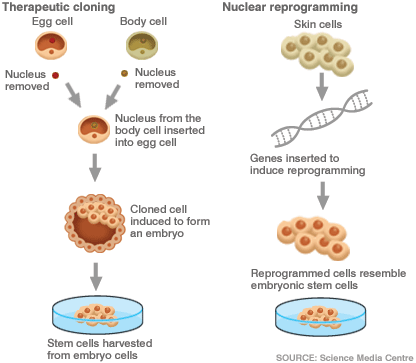
  • Therapeutic cloning produces stem cells which can develop into different types of body cell, making them ideal for research into treatment of disease.

  • But this technology involves the creation and destruction of embryos, which is ethically controversial. The stem cells created also run the risk of being rejected by the body.

  • The new technology, nuclear reprogramming, creates stem-like cells from the patient's own cells, avoiding both these problems.

AddThis Social Bookmark Button

Saturday, December 01, 2007

Scientists Breed Mouse That Can't Get Cancer

Meet the supermouse bred by genetic scientists that CAN'T get cancer

Mice resistant to cancer have been created in a breakthrough that could lead to a human treatment free of side-effects.

A protein produced by the creatures may hold the key to a future therapy.

It attacks tumour cells, but does not harm healthy tissue in the body.

Scientists hope it can one day be adapted for use in humans - saving them the pain, nausea and hair loss usually associated with cancer treatments.

The breakthrough hinges on a mouse gene called Par-4, which produces the protein. U.S. researchers genetically engineered a group of mice to have higher levels of the protein than normal.

These creatures were found to be immune to many forms of the disease, such as cancer of the liver and prostate, the journal Cancer Research reports.

Tests suggest the protein could also beat off breast, pancreatic and head and neck cancers.

Crucially, the animals did not suffer any visible side-effects, the U.S. scientists said.

AddThis Social Bookmark Button

Tuesday, November 27, 2007

Nanosolar's Breakthrough - Solar Now Cheaper Than Coal

Nanosolar’s Breakthrough - Solar Now Cheaper than Coal

Their mission: to deliver cost-efficient solar electricity. The Nanosolar company was founded in 2002 and is working to build the world’s largest solar cell factory in California and the world’s largest panel-assembly factory in Germany. They have successfully created a solar coating that is the most cost-efficient solar energy source ever. Their PowerSheet cells contrast the current solar technology systems by reducing the cost of production from $3 a watt to a mere 30 cents per watt. This makes, for the first time in history, solar power cheaper than burning coal.

These coatings are as thin as a layer of paint and can transfer sunlight to power at amazing efficiency. Although the underlying technology has been around for years, Nanosolar has created the actual technology to manufacture and mass produce the solar sheets. The Nanosolar plant in San Jose, once in full production in 2008, will be capable of producing 430 megawatts per year. This is more than the combined total of every other solar manufacturer in the U.S.

AddThis Social Bookmark Button

Monday, November 26, 2007

Nuke to the Future!

Nuke to the Future

The portable nuclear reactor is the size of a hot tub. It’s shaped like a sake cup, filled with a uranium hydride core and surrounded by a hydrogen atmosphere. Encase it in concrete, truck it to a site, bury it underground, hook it up to a steam turbine and, voila, one would generate enough electricity to power a 25,000-home community for at least five years.

The company Hyperion Power Generation was formed last month to develop the nuclear fission reactor at Los Alamos National Laboratory and take it into the private sector. If all goes according to plan, Hyperion could have a factory in New Mexico by late 2012, and begin producing 4,000 of these reactors.

Though it would produce 27 megawatts worth of thermal energy, Hyperion doesn’t like to think of its product as a “reactor.” It’s self-contained, involves no moving parts and, therefore, doesn’t require a human operator.

“In fact, we prefer to call it a ‘drive’ or a ‘battery’ or a ‘module’ in that it’s so safe,” Hyperion spokeswoman Deborah Blackwell says. “Like you don’t open a double-A battery, you just plug [the reactor] in and it does its chemical thing inside of it. You don’t ever open it or mess with it.”

AddThis Social Bookmark Button

Tuesday, November 20, 2007

Nano Cancer Bombs And Mini Organs From MIT

Nano cancer-bombs and mini organs from MIT

Scientists at MIT have developed remote-controlled nano particles that, with the push of a button, can deliver drugs directly to a tumour. The same research director has also found a way to build tiny human "livers" just 500 micrometres across. This work should lead to more reliable toxicity testing for new drugs.

According to Geoff von Maltzahn, post-doctoral researcher at the Harvard-MIT division of health sciences & technology (HST), the nano particles are first persuaded to clump together, which makes it easier to track their progress through a patient's body. Then, drug molecules are attached to the clumps of nanoparticles with DNA tethers and the whole lot is injected into the patient.

The nanoparticles are then tracked with an MRI scanner (hence the clumping). When they get to their target they are pulsed with an electromagnetic field at between 350-400kHz. This is harmless to the human body, but melts the tether and releases the drugs exactly where they are needed.

The breakthrough rests on a property of the nanoparticles: superparamagnetism. This characteristic causes them to give off heat when they are exposed to a magnetic field. This heat breaks the connection with the DNA tether, and allows the system to deliver the drugs.

Using DNA as the tether has another advantage: it makes it possible to choose the EM frequency that will break the bond, since longer or differently arranged strands will have different melting points. This means one clump of nanoparticles can carry multiple doses of drugs to several sites. If each drug has differently tuned DNA tethers, doctors can use a different EM frequency to deliver each dose.

AddThis Social Bookmark Button

Sunday, November 11, 2007

Second Life Brain-Computer Interface, Thought Controlled Technology

Brain-computer interface for Second Life

While recent developments in brain-computer interface (BCI) technology have given humans the power to mentally control computers, nobody has used the technology in conjunction with the Second Life online virtual world — until now.

A research team led by professor Jun’ichi Ushiba of the Keio University Biomedical Engineering Laboratory has developed a BCI system that lets the user walk an avatar through the streets of Second Life while relying solely on the power of thought. To control the avatar on screen, the user simply thinks about moving various body parts — the avatar walks forward when the user thinks about moving his/her own feet, and it turns right and left when the user imagines moving his/her right and left arms.

The system consists of a headpiece equipped with electrodes that monitor activity in three areas of the motor cortex (the region of the brain involved in controlling the movement of the arms and legs). An EEG machine reads and graphs the data and relays it to the BCI, where a brain wave analysis algorithm interprets the user’s imagined movements. A keyboard emulator then converts this data into a signal and relays it to Second Life, causing the on-screen avatar to move. In this way, the user can exercise real-time control over the avatar in the 3D virtual world without moving a muscle.


New Technology Can Be Operated By Thought
Neuroscientists have significantly advanced brain-machine interface (BMI) technology to the point where severely handicapped people who cannot contract even one leg or arm muscle now can independently compose and send e-mails and operate a TV in their homes. They are using only their thoughts to execute these actions.

Thanks to the rapid pace of research on the BMI, one day these and other individuals may be able to feed themselves with a robotic arm and hand that moves according to their mental commands.

...

In previous studies, this lab developed the technology to tap a macaque monkey's motor cortical neural activity making it possible for the animal to use its thoughts to control a robotic arm to reach for food targets presented in 3D space.

In the Pittsburgh lab's latest studies, macaque monkeys not only mentally guided a robotic arm to pieces of food but also opened and closed the robotic arm's hand, or gripper, to retrieve them. Just by thinking about picking up and bringing the fruit to its mouth, the animal fed itself.

The monkey's own arm and hand did not move while it manipulated the two-finger gripper at the end of the robotic arm. The animal used its own sight for feedback about the accuracy of the robotic arm's actions as it mentally moved the gripper to within one-half centimeter of a piece of fruit.

"The monkey developed a great deal of skill using this physical device," says Meel Velliste, PhD. "We are in the process of extending this type of control to a more sophisticated wrist and hand for the performance of dexterous tasks."

AddThis Social Bookmark Button

Researchers Simulate Photosynthesis, Design Better Leaf

Researchers successfully simulate photosynthesis and design a better leaf

University of Illinois researchers have built a better plant, one that produces more leaves and fruit without needing extra fertilizer. The researchers accomplished the feat using a computer model that mimics the process of evolution. Theirs is the first model to simulate every step of the photosynthetic process.

...

Photosynthesis converts light energy into chemical energy in plants, algae, phytoplankton and some species of bacteria and archaea. Photosynthesis in plants involves an elaborate array of chemical reactions requiring dozens of protein enzymes and other chemical components. Most photosynthesis occurs in a plant’s leaves.

...

It wasn’t feasible to tackle this question with experiments on actual plants, Long said. With more than 100 proteins involved in photosynthesis, testing one protein at a time would require an enormous investment of time and money.

“But now that we have the photosynthetic process ‘in silico,’ we can test all possible permutations on the supercomputer,” he said.

...

Using “evolutionary algorithms,” which mimic evolution by selecting for desirable traits, the model hunted for enzymes that – if increased – would enhance plant productivity. If higher concentrations of an enzyme relative to others improved photosynthetic efficiency, the model used the results of that experiment as a parent for the next generation of tests.

This process identified several proteins that could, if present in higher concentrations relative to others, greatly enhance the productivity of the plant. The new findings are consistent with results from other researchers, who found that increases in one of these proteins in transgenic plants increased productivity.

“By rearranging the investment of nitrogen, we could almost double efficiency,” Long said.

AddThis Social Bookmark Button

Friday, October 26, 2007

Photorealism, Part Deux!

A little while ago, I posted How Long Until Photorealistic Virtual Environments?

But that was before I had seen this:

AddThis Social Bookmark Button

Monday, October 22, 2007

HIV Cure Found

Researchers Knock Out HIV

With the latest advances in treatment, doctors have discovered that they can successfully neutralise the HIV virus. The so-called ‘combination therapy’ prevents the HIV virus from mutating and spreading, allowing patients to rebuild their immune system to the same levels as the rest of the population.

To date, it represents the most significant treatment for patients suffering from HIV.

Professor Jens Lundgren from the University of Copenhagen, together with other members of the research group EuroSIDA, have conducted a study, which demonstrates that the immune system of all HIV-infected patients can be restored and normalised. The only stipulation is that patients begin and continue to follow their course of treatment.

...

Combination therapy prevents the virus from forming and mutating in human beings. When the virus is halted in its progress, the number of healthy CD4+T cells begins to rise and patients, who would otherwise die from HIV, can now survive. The immune system is rejuvenated and is apparently able to normalise itself, providing that the combination therapy is maintained. The moment the immune system begins to improve, the HIV-infected patient can no longer be said to be suffering from an HIV infection or disease, already declining in strength.

This thin-section transmission electron
micrograph depicted the ultrastructural
details of two "human immunodeficiency
virus" (HIV) virus particles, or virions.


It sounds to me like HIV is basically cured.

It wasn't too long ago that HIV meant your end.

I clearly remember watching the documentaries on TV when I was still a kid and HIV was still a hot topic.

I've seen the people who had HIV talk in front of the camera. They looked enormously time-ravaged. Some of them were just 1 tan-shade away from that of a corpse.

It's kind of strange to have seen HIV rise and fall within my own lifetime.

Once a death sentence. Now a manageable ailment.

We are now clearly seeing the very beginnings of the biotechnology revolution that will leave a big footprint on the next decade.

Cancer will be going the same way.

Future generations will never have to deal with this shit.

Only we, who are adults A.D. 2007, will remember the havoc that these diseases once wreaked upon our frail bodies...

AddThis Social Bookmark Button

Tuesday, October 16, 2007

How Long Until Photorealistic Virtual Environments?

My guess would be... not long.

AddThis Social Bookmark Button

Sunday, October 14, 2007

Why Can't We Regrow Bodyparts?

Why can't we regrow bodyparts?

Well, as it turns out...

We can, in fact, regrow bodyparts.


Also see my previous post that is more detailed about the regrowing fingertip story.

Here's a link to the original page.

AddThis Social Bookmark Button

Tuesday, October 09, 2007

Regrowing Fingers - Tissue Regeneration Technology Already Exists

A Doctor, a Pig, and a Magical Pixie Dust That Could Regrow Fingers

...

Spievack had never seen a plane act this way. He got down on his knees for a closer look, and just as he said, "You've got to get rid of this thing," he pointed at the engine, inserting his middle finger directly into the propeller's path. "And that's how I cut my finger off," he says.

Over the years, Dr. Stephen Badylak has had problems explaining what he does for a living. He used to say, "I do biomedical engineering." But then he'd have to explain biomedical engineering. After a while, as a default response, Badylak would simply say, "Well, I'm in medical research." He hoped that would be enough, but it often prompted, "What are you researching?" Badylak says, "I got tired of struggling with it. So now I just tell them I make body parts." Badylak has regrown sizable portions of esophagi, tendons, ligaments, bladders, urethras, abdominal walls, blood vessels, and hearts within animals and humans.

...

But that life would be a lot better for a lot of people if their bodies could be manipulated into fixing and replacing lost or damaged body parts -- similar to what happens to fetuses the first few months in the womb. If a fetus loses an arm or a leg, it grows back. "Humans can grow an entire human being in nine months. That's pretty remarkable," says Badylak. "If you think about it that way, you can say we just want an arm, you know, or we want a leg. Just give us enough information that we can do that."

...

A few days after Lee Spievack canceled his appointment with the hand surgeon, he received a package from his older brother containing a vial of powder that looked like Kraft Parmesan cheese. His brother instructed him to sprinkle it on his finger every other day until the powder was gone.

Lee Spievack is not a man who asks a lot of questions. So in the case of the vial, Spievack didn't much care what it contained (ground-up pig bladder) or where it came from (a little farm in Albion, Indiana).

...

Spievack followed his brother's directions: Every other day for the next eight days, he sat down at his living-room coffee table and sprinkled the powder on his finger. Whatever powder fell onto the table he scooped up with a piece of paper, then dropped back into the vial. He covered his finger with a Band-Aid. A few days went by, and Spievack could see something was happening. There was skin growing, and tissue on the inside, too. He insists that what happened after four weeks did not surprise him in the least, though it should have. Because his fingertip grew back.

The fingerprint took a couple more months. The tip is a little hard on the end, but he can feel things just fine. Spievack says he was particularly happy this past winter; while all of his fingers chapped in the cold weather, the new fingertip didn't. The only side effect during treatment was that his finger began to smell like a pig's quarters at the state fair. "It was a pretty offensive odor," Spievack says. He doesn't much think about his finger anymore, except when he clips his nails. He usually cuts them once a week, but the new nail has to be clipped every two days. "That fingernail grows like a son of a bitch," he says.

This is just bizarre.

And to think that Badylak had problems convincing other people of his findings.

Only Spievack took him seriously end they teamed up.

If only people were a little more open-minded to possibilities... technologies like these would already be widely used.

And we wouldn't be having such a hard time convincing people of the very real possibility of immortality within our lifetimes.

AddThis Social Bookmark Button

Sunday, October 07, 2007

Artificial Cornea Gives Hope To The Blind

Artificial Cornea Gives Hope To The Blind

German researchers have developed an artificial cornea that promises easy integration with a patient's native cornea, and prevents cellular hyperplasia on its plastic surface

...

Researchers in Dr. Karin Kobuch's working group at Regensburg University Hospital have already tested these corneas in the laboratory and found that their cells graft very well at the edge and cease growing where the coating stops. The optical center of the implant thus remains clear. The first implants have already been tested in rabbits' eyes - with promising results. If further tests are successful, the technology will be tried on humans in 2008.

AddThis Social Bookmark Button

Wednesday, October 03, 2007

Robot Car To Compete In Darpa Urban Challenge

A Land Rover That Drives Itself

In an airplane hanger on MIT's campus in Cambridge last week, a team of engineering students and researchers put the finishing touches on Talos, a Land Rover that drives itself. Talos is MIT's entry in the Defense Advanced Research Project Agency's (DARPA) robotic car race, which will take place on November 3, in Victorville, CA.

Known as the Urban Challenge, the race will test the ability of robotic cars from 35 different teams to obey traffic laws and drive safely in a city-like environment without human assistance. The vehicles will need to find their way to a preprogrammed destination while paying attention to lane markers, other cars, and unexpected obstacles, such as potholes in the road. (See video.)

The Urban Challenge is a follow-up to DARPA's Grand Challenge race, held in 2004 and 2005, in which cars navigated an empty desert road. The new, more complex racing environment reflects the rapid progress being made in robotic cars: while none of the teams finished the first Grand Challenge race, 5 out of 23 cars finished the second one. Stanford University's team, which won the latter race, will enter the Urban Challenge with Junior, an upgraded version of its winning car. (See "Stanford's New Driverless Car.")

In order to "see" its environment, MIT's Talos is equipped with numerous laser range finders, radar units, Global Positioning Systems, and video cameras, explains Emilio Frazzoli, a professor of aeronautics and astronautics and one of the team leaders. The researchers developed novel software--which runs on 10 quad-core computers in the Land Rover's trunk--to make sense of the incoming data and to calculate the car's next move. The 40 processors produce so much heat that the team added an air-conditioning unit to the roof of the car. (See slide show.)


Also see:

AddThis Social Bookmark Button