Wednesday, March 15, 2006

Nanofactory Movie - Improved

A good while ago, John Burch (fan of this blog ;) and Eric Drexler (father of the nanotechnology field) produced a 4-minute movie that takes an inside look inside a nanofactory. The nanofactory in the movie has been simulated. The simulations show that it would actually work like this if it existed in the real, physical world.

The nanofactory demonstrates the steps that are necessary to print superproducts (outperforming our current products by a factor of 1000), layer by layer. In this case, a one billion CPU laptop with a 100 hour battery life is produced.


CNano reports that the movie has now been improved with better visuals, comments and sound effects.

The movie can be downloaded here.

You don't want to miss out on this. Trust me.

AddThis Social Bookmark Button

Nanotechnology Restores Sight Of Blind Hamsters

Nanotech Helps Blind Hamsters See

Nanotechnology has restored the sight of blind rodents, a new study shows.

Scientists mimicked the effect of a traumatic brain injury by severing the optical nerve tract in hamsters, causing the animals to lose vision.

After injecting the hamsters with a solution containing nanoparticles, the nerves re-grew and sight returned.

Writing in the Proceedings of the National Academy of Sciences, the team hopes this technique could be used in future reconstructive brain surgery.

...

The researchers injected the blind hamsters at the site of their injury with a solution containing synthetically made peptides - miniscule molecules measuring just five nanometres long.

Once inside the hamster's brain, the peptides spontaneously arranged into a scaffold-like criss-cross of nanofibres, which bridged the gap between the severed nerves.

The scientists discovered that brain tissue in the hamsters knitted together across the molecular scaffold, while also preventing scar tissue from forming.

Importantly, the newly formed brain tissue enabled the brain nerves to re-grow, restoring vision in the injured hamsters.

"We made a cut, put the material in, and then we looked at the brain over different time points," explained Dr Rutledge Ellis-Behnke, a neuroscientist at MIT and lead author on the paper.

"The first thing we saw was that the brain had started to heal itself in the first 24 hours. We had never seen that before - so that was very surprising."

Sounds like a major breakthrough to me...

Makes you wonder what will be possible only a few years from now, say 2010.

AddThis Social Bookmark Button

Tuesday, March 14, 2006

Nanotechnology Could Improve Solar Cells

Nanotechnology Could Improve Sattelites And Solar Cells

More efficient space solar cells could mean better imagery satellites and improved solar energy technology.

Scientists at the NanoPower Research Labs at Rochester Institute of Technology, led by director Ryne Raffaelle, are using nanotechnology to explore this possibility through a project funded by an $847,109 grant from the U.S. Department of Defense. The project aims to take current state-of-the-art solar cells used for space power to the next level by developing nanostructured materials and, ultimately, by producing nanostructured cells. The program may extend to three and half years, with total funding reaching $3 million.

"If successful, the results of this program will improve current solar array and satellite technology, and lay the foundation for long-term improvement in our ability to use solar energy," Raffaelle says.

Unique to this project is the ability to exploit the fundamental behavior of nanoscale crystals, also known as quantum dots, which alter the way a solar cell absorbs light and converts it into electricity. According to Raffaelle, the electrical, optical, mechanical and even thermal properties of nanomaterials can be controlled by changing the particle size, making them highly useful in semiconductor device development.

...

"The use of the quantum confinement offered by nanostructured materials provides us with a new means of breaking out of the normal design constraints associated with ordinary crystalline device growth," says Raffaelle. "The theoretical improvements that this can provide are truly remarkable. It's our job to turn these theories into experimental realities."

There are many more posts on progress in solar panels on my blog. Too many to link back to. Check the archives if you're interested.

AddThis Social Bookmark Button

Research On The Road To Intelligent Cars

Research On The Road To Intelligent Cars

Although intelligent ICT-based systems already exist, their market take-up has been very slow. Reasons for this include legal and institutional barriers, competition among car-makers, the relatively high cost of intelligent systems, lack of customer demand, and above all a general lack of information on and awareness of the potential benefits of such systems.

Partly to counter this, the PReVENT integrated project is devoting 55 million euro to the safety of drivers, passengers and pedestrians. Including over 50 partners, it is made up of sub-projects covering specific road traffic and accident situations.

"What we have are car-safety systems that can support the driver in critical situations," says Maxime Flament PReVENT manager from ERTICO. In essence, the preventive safety applications help a driver to avoid or mitigate accidents by sensing the nature and significance of the danger, while taking into account the driver's own state. But this technology must not take control away from drivers, which would restrict user-acceptance.

Take for instance, the MAPS&ADAS sub-project that is creating safety-enhanced digital maps for a variety of other applications other than just route guidance. "We use digital maps as a predictive sensor," says Vincent Blervaque, project coordinator from ERTICO. "They complement other vehicle speed and position sensors such as lasers and video cameras, which have limited range, to extend the driver horizon at least 300 to 500 metres ahead. For example, a driver can be alerted to what is coming after the next road curve or intersection."

By look at it, I'd say cars will probably be doing a great deal of our driving for us by the time we get to 2020.

Having a rough time imagining how that might happen so soon?

Then be sure to read Driverless Cars Race 130 Miles.

AddThis Social Bookmark Button

Long Distance Lovers Virtually Share Drink

Some progress on the virtual environment front...

Long Distance Lovers Virtually Share Drink

Long distance lovers could soon be able to bond by sharing a wi-fi glass of wine.

Researchers at MIT's Media Lab in Boston say the idea is to give the feeling of a shared drinking experience.

The high-tech glasses will glow warmly when raised, no matter how far apart the drinkers are, reports New Scientist.

Jackie Lee and Hyemin Chung, experts in human-computer interaction, say that communal drinking is an important social interaction that helps bind friendships and relationships.

Lee and Chung have incorporated a variety of coloured LEDs, liquid sensors and wireless links into a pair of glass tumblers.

When either person picks up a glass, red LEDs on their partner's glass glow gently. And when either puts the glass to their lips, sensors make white LEDs on the rim of the other glass glow brightly.

Following tests in separate labs, Lee says the wireless glasses really do "help people feel as if they are sharing a drinking experience together".

The glasses, dubbed lover's cups, will be unveiled at the CHI 2006 conference on computer-human interaction in Montreal in April.


Also see The Future Of Virtual Environments.

AddThis Social Bookmark Button

Thought Controlled Shark As Stealth Spies

After two posts about thought control (see mental typewriter and cyberhand), just one more isn't going to hurt.

Thought Controlled Sharks

The Pentagon is working on using remote-controlled sharks as stealth spies.

Engineers funded by the US military have created a neural implant designed to enable a shark's brain signals to be manipulated remotely.

The Pentagon hopes to exploit sharks' natural ability to glide quietly through the water, sense delicate electrical gradients and follow chemical trails, reports New Scientist.

The project, funded by the Defense Advanced Research Projects Agency, was presented at the Ocean Sciences Meeting in Honolulu, Hawaii.

Neural implants consist of a series of electrodes are embedded into the animal's brain, which can then be used to stimulate various functional areas.

Biologist Jelle Atema of Boston University and his students are using them to "steer" spiny dogfish in a tank via a phantom odour.

Project engineer Walter Gomes, of the Naval Undersea Warfare Centre, says the next step will be to implant the device into blue sharks and release them into the ocean off the coast of Florida.

AddThis Social Bookmark Button

Doctors Find Holy Grail Of Heart Disease

Doctors Find Heart Disease Holy Grail

A new drug is being hailed as the "holy grail" in the fight against heart disease.

Doctors believe they may have found a way of reversing the illness for the first time.

The health of more than two million people in the UK is thought to be affected by arteries narrowed by the build-up of fatty deposits.

The process, known as atherosclerosis, can lead to potentially fatal conditions including heart attacks and strokes.

In the past, medical experts focused their efforts on slowing the progress of what was thought to be an irreversible disease.

But a new study shows a powerful new cholesterol-reducing drug can also reduce the deposits, known as atheroma.

Patients were given intensive treatment with a new form of statin, a type of drug used to reduce cholesterol levels, known as Rosuvastatin.

Tests found that as cholesterol was reduced, build-ups of fatty deposits in the patients' arteries also showed a slight regression, with some reduction in the level of atherosclerosis in 78% of patients.

The reductions were found to be greatest in the arteries with the greatest severity of the disease.

Dr Neal Uren said atheroma reduction was the "holy grail" in the fight to combat heart disease.

AddThis Social Bookmark Button

Sunday, March 12, 2006

Cyberhand - Thought Controlled Robot Hand With Feeling

I've posted a thought control related post recently, and found another one that matches nicely with that previous post.

Have a look at this cyberhand.


... Now a team of European scientists led by Paolo Dario, a professor of biomedical robotics at the Scuola Superiore Sant’Anna in Pisa, Italy, has unveiled the first brain-controlled prosthetic hand. The metal-clad prototype, dubbed the Cyberhand, combines unprecedented mechanical dexterity with a sophisticated computer system designed to harness brain signals from the wearer, allowing him to move and feel the hand as though it were his own.

Dario and his team expect to begin testing the Cyberhand on patients this year, during which time they aim to perfect its sensory interface. Consisting of a microprocessor, electrodes and a telemetry system implanted in the wearer’s lower arm, the interface will act as a sort of man-machine interpreter, translating and ferrying electrical signals back and forth between the hand and the patient’s central nervous system. To do this, the team has invented electrodes that record electrical data from nerve cells and stimulate the cells to provide the wearer with sensory feedback. Current systems do just half the job, recording electrical signals without sending any data back to the brain.

In addition to its ability to communicate with the body, the Cyberhand features a number of mechanical advances, including five independently moving fingers. A DC motor in each digit gives the robotic hand 16 degrees of freedom, so it can move in a variety of subtle directions (the human hand has 22 degrees of freedom). Each motor pulls a Teflon-sheathed cable that mimics actual tendons and muscle in the fingers, enabling them to curl around a coffee mug, for instance. With pressure sensors embedded along the surface of the fingers, the hand can pick up even delicate objects without crushing them.


I wonder for how long advanced prosthetics like these will be useful, as stem cell therapy tantalizingly promises us to regrow our organs and limbs.

However, if these robotic appendages were to eventually become better than our own biological limbs, things could get very interesting...

AddThis Social Bookmark Button

Heart Patients Keen On Stem Cell Therapy

I've seen dozens of news articles about heart patients getting benefit from experimental stem cell therapies. It's about time I post one.

Australian scientists have had no shortage of patients willing to undergo experimental stem cell treatment for heart disease.

Although the procedure is still unproven, volunteers lining up to trial stem cell therapy have reached the end of the road in terms of conventional medicine.

Sydney man Bill Henry had 80 million stem cells injected into his ailing heart a month ago via a catheter through his groin.

The 52-year-old is one of two patients to have the world-first procedure and is already talking about the possibility of returning to full-time employment.

When reading news like this, you've gotta feel thankful that we won't be worrying about heart disease anymore a few years from now.

Not that stem cell therapies are limited to the heart alone...

AddThis Social Bookmark Button

Saturday, March 11, 2006

Brain Swapping Comes Of Age

Brain Swapping Comes Of Age:

For more than two decades, Evan Balaban has honed his skills at manipulating embryonic tissue samples using tiny instruments of his own making. He can cut a small access window into a quail's egg, and using a scalpel no wider than a human hair, excise a few hundred thousand cells from the bird's developing central nervous system. This is only the first step of the intricate process required to place this minuscule brain into another animal's head. Some of these surgeries end in untimely death for brain-transplanted embryos, but Balaban says he has elevated the typical survival rate from less than 20% to more than 60%. That was unimaginable in the 1950s, he says, when success was more along the lines of one or two in 1,000, and some researchers "were doing this with piano wire."

...

Balaban's work focuses on how nature and nurture blend together to create a seamless set of brain circuits. Other brain-swappers have focused on how brain structure makes males and females different, or how dysfunctional circuitry manifests itself in congenital abnormalities such as epilepsy.

Simply amazing, isn't it?

AddThis Social Bookmark Button

Anti Aging Breakthroughs May Add 25 Years To Life

It looks like the mainstream media is catching on to idea of dramatic life extension:

Imagine living to age 50 sans wrinkles, without relinquishing any youthful gaiety, to maybe even see your great-granddaughter's high school education. Sounds implausible, but science is working on it.

Recent research is beginning to reveal anti-aging technologies which could prolong life-spans a full 25 years.

...

The War On Aging

De Grey calls the time during which the technologies will experience the most development the War On Aging.

"I use the phrase to describe the period starting when we get results in the laboratory with mice that are impressive enough to make people realize that life extension is possible, and ending when the first effective therapies for humans are developed," de Grey said. "I estimate that the War On Aging will start 10 years from now, subject to funding of research, and will last for 15 years, but this latter estimate is extremely speculative."

Also see The Quest For Immortality

AddThis Social Bookmark Button

One Million To Fund Limb Growth Trials

$1M to fund clinical limb regrowth trials:

Thousands of wounded soldiers could benefit from clinical trials that will study the possibility of growing back severed limbs and other body parts, officials at the University of Pittsburgh said Friday.

Five trials focusing on regenerative medicine could start within the next year using a $1 million grant announced yesterday by U.S. Sen. Rick Santorum, R-Penn Hills.

Santorum made the announcement at Pitt's McGowan Institute for Regenerative Medicine, where scientists have been working on cell-based methods to regrow damaged or destroyed muscle, bone and tissue.

...

The grant also will support the creation of the new Soldier Treatment and Regeneration Consortium, a national partnership of military and academic research centers and industry.

...

The consortium's five-year goal is the creation of a fully functional finger.

Imagine a world where we can regrow spare parts for our aging/wounded bodies. Wouldn't that be fantastic?

Another one on fast growing stem cells:
A team of researchers has succeeded in engineering stem cells taken from tooth germ to quickly develop into liver or bone tissue, the National Institute of Advanced Industrial Science and Technology's Research Institute (AIST) for Cell Engineering said.

A joint team of scientists from the institute and Osaka University succeeded in repairing damaged liver and bones in rats using stem cells taken from wisdom tooth germ.

The finding raises hopes of developing regenerative medicine using wisdom teeth germ taken from people during orthodontic treatments.

...

A team of researchers has succeeded in engineering stem cells taken from tooth germ to quickly develop into liver or bone tissue, the National Institute of Advanced Industrial Science and Technology's Research Institute (AIST) for Cell Engineering said.

A joint team of scientists from the institute and Osaka University succeeded in repairing damaged liver and bones in rats using stem cells taken from wisdom tooth germ.

The finding raises hopes of developing regenerative medicine using wisdom teeth germ taken from people during orthodontic treatments.

AddThis Social Bookmark Button

Friday, March 10, 2006

Thought Controlled Mental Typewriter

Thought Controlled Mental Typewriter:

A computer controlled by the power of thought alone has been demonstrated at a major trade fair in Germany.

The device could provide a way for paralysed patients to operate computers, or for amputees to operate electronically controlled artificial limbs. But it also has non-medical applications, such as in the computer games and entertainment industries.

...

The machine makes it possible to type messages onto a computer screen by mentally controlling the movement of a cursor. A user must wear a cap containing electrodes that measure electrical activity inside the brain, known as an electroencephalogram (EEG) signal, and imagine moving their left or right arm in order to manoeuvre the cursor around.

...

Curio says users can operate the device just 20 minutes after going through 150 cursor moves in their minds. This is because the device rapidly learns to recognise activity in the area of a person's motor cortex, the area of the brain associated with movement. "The trick is the machine-learning algorithms developed at the Fraunhofer Institute," Curio says.

John Chapin, an expert in using implanted electrodes to control computers, agrees EEG sensing technology is advancing rapidly. "There's been a lot of progress on the non-invasive side in recent years," he told New Scientist.

The German researchers hope to develop a commercial version of the device as an aid for paralysed patients and amputees.

Chapin adds that brain-computer interfaces could have a range of uses beyond the medical. "Signals from the brain give you a fraction of a second advantage," he says. The device could make a novel game controller and be used in other ways. The researchers have even begun testing the machine as a driving aid, as it can sense a sudden reaction and control a vehicle's brakes before even the driver can.

AddThis Social Bookmark Button

Thursday, March 09, 2006

Tree Climbing Robot

After the packmule robot, there is now a tree climbing robot (this links to a must-see movie clip).

The robot is being built by researchers from Carnegie Mellon and several other US Universities. It is part of the RiSE project, which aims to build a walking and climbing robot.

The goal of the RiSE project is to create a bioinspired climbing robot with the unique ability to walk on land and climb on vertical surfaces.

...

This project is funded by the DARPA Biodynotics Program.

Robotics is moving very fast these days. It's fascinating to see all this wonderful technology materialize.

AddThis Social Bookmark Button

Google To Provide Infinite Storage Space

Only yesterday, I posted something about The Future Of Computers. That post was mainly about computers shrinking and becoming really small in the future.

Also of relevance to the future of computers is a high degree of decentralization.

And Google realizes it better than anybody else.

Google Inc. apparently hopes to persuade everyone with a computer to entrust all their digital data with the online search engine leader, even though the company is having trouble controlling its own internal communications.

Plans for a Google service offering "infinite" storage capacity leaked out last week when the company inadvertently shared some information about several projects, including one named "GDrive," on its Web site.

Google quickly removed the previously confidential notes, but not before some eagle-eyed Web surfers had already made copies. Excerpts remain available on some Web sites.

In its internal notes, Google discusses an ambitious storage system that would keep its users' word processing files, e-mails, Web history and photos on the company's own computers. Google believes the service would be enticing because the information would be unleashed from a single computer in a home or office, allowing users to access their data from any place at any time.


Nobody is supposed to know about Google's GDrive plans yet, but Google accidentily leaked some memo's. Excerpts from the memo can be found here.

We won't have to wait for the future in order to start storing our files online, though. A Gmail Drive Shell is already available right now. It allows you to store files to your Gmail account by simply dragging them in there from your explorer window.

AddThis Social Bookmark Button

Wednesday, March 08, 2006

The Future Of Computers (5)

I read a few articles recently that were all related to one topic. Namely the ongoing trend in the miniaturisation of computers.

I have written about shrinking computers in my blogpost series The Future Of Computers.

And here's some extra info showing that the trend is still going strong.


1. Notebook-Ready Fuel Cell To Be Shown Next Week

The methanol-powered Antig fuel cell provides 45 watts of power on a single "tank" of methanol, and weighs 3.7 pounds (1.7 kg). In total, the additional power should be enough to operate the notebook for eight hours, AVC said, which was responsible for engineering the fuel cell into the notebook housing.

Fuel cells are important because they provide more power than conventional energy sources while taking up the same volume.


2. Spansion Tips 45-nm, Quad-bit Flash
As part of the roadmap, Spansion (Sunnyvale, Calif.) dropped hints about a quad-bit, NAND-like product line that is targeted for the 45-nm node in 2008.

Beyond the so-called Quad Bit line, there were no roadmap surprises at Spansion, which is experiencing a string of losses amid a downturn in the NOR flash market. The company — formerly the NOR flash venture between Advanced Micro Devices Inc. (AMD) and Fujitsu Ltd. — recently went public.

...

By year’s end, Spansion hopes to move to a 65-nm process in its flagship Fab 25 facility in Austin, Texas. The company’s Fab 25 plant is also making 110- and 90-nm devices as well. Its foundry partner, Taiwan Semiconductor Manufacturing Co. Ltd., is also ramping up 110-nm parts, according to Spanion.

And by 2008, it hopes to migrate to a four-bit-per-cell architecture, dubbed Quad Bit, based on a 45-nm process. The company did not disclose details about the product.

A size of 45 nanometers is half of what our CPU's components are at the time of writing, which is 90 nanometers. And not only are dimensions shrinking, we are also stuffing more bits in one cell. Current memory chips store only one bit per cell.

A cell stores an electrical charge, which can be either low or high, corresponding to a zero or a one (I'm not sure if that's the correct order though), which is essentially one bit.

These future flash chips are able to store 4 bits in one cell.

That's a good way of stuffing more information in the same volume, and thereby (since everything is relative) shrinking memory modules.


3. Philips Produces 65nm System On A Chip
Royal Philips Electronics today announced it is securing its position at the leading edge of low-power CMOS technology for consumer-product applications, by successfully implementing a right-first-time 65-nm System-on-Chip (SoC) with the design complexity required in next-generation mobile multimedia and home entertainment products such as 3G mobile phones and high-performance LCD TVs.

Featuring an IEM™ (Intelligent Energy Manager) technology-enabled ARM1176JZF-S™ processor, 512 Kbytes of high-speed low-power scratch-pad memory, high-speed communication ports and key analog IP blocks, the new Philips chip is the first truly consumer-product oriented SoCs to be successfully produced in 65-nm low-power CMOS. It has been designed, as a platform to demonstrate what next-generation consumer products will be able to deliver in terms of a rich multimedia experience coupled with sense and simplicity of operation. It is already at the heart of new 65-nm CMOS SoCs currently in an advanced stage of development at Philips.

...

Extensive testing has already seen the new Philips SoC booting and running the Linux operating system, which is rapidly gaining favor in the consumer-electronics market due to its modularity, scalability, open-source philosophy and low-cost development tool support.

The term system on a chip is gaining popularity. It means exactly what it says. It's a whole system on just one chip, as opposed to the big pc cases filled with components that are now required to build one system.

Also very impressive is that Philips has managed to run the Linux OS on it.


So all in all, this once again shows we're looking at a future filled with extremely small computers.
AddThis Social Bookmark Button

Tuesday, March 07, 2006

Robotic Packmule Displays Stunning Reflexes

Robotic Packmule Displays Stunning Reflexes:

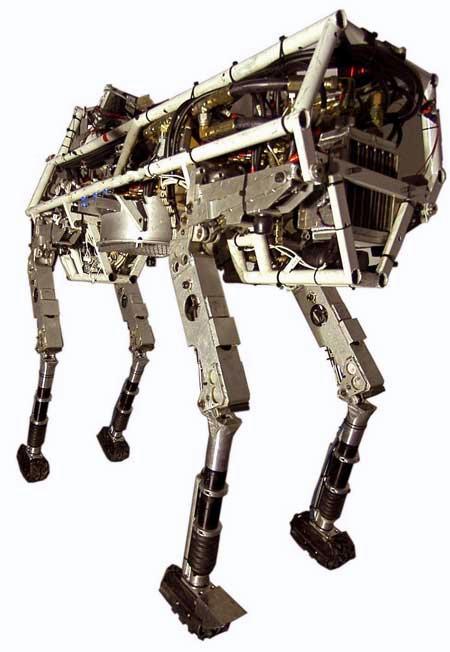
A nimble, four-legged robot is so surefooted it can recover its balance even after being given a hefty kick. The machine, which moves like a cross between a goat and a pantomime horse, is being developed as a robotic pack mule for the US military.

BigDog is described by its developers Boston Dynamics as “the most advanced quadruped robot on Earth”. The company have released a new video of the robot negotiating steep slopes, crossing rocky ground and dealing with the sharp kick. View the impressive clip here (28MB Windows media file).

“Internal force sensors detect the ground variations and compensate for them,” says company president and project manager Marc Raibert. “And BigDog's active balance allows it to maintain stability when we disturb it."

This active balance is maintained by four legs, each with three joints powered by actuators and a fourth "springy" joint. All the joints are controlled by an onboard PC processor.

(click to enlarge)


It hasn't been long since Asimo the robot learned to walk and then run. Now there is a robot which does an impressive job at maintaining its balance, even if it receives a forceful kick.

As robots are getting smarter, they will start taking over many of our jobs that require only basic cognitive skills, such as window washing, dish washing, etc. This is going to have certain implications for our society as a whole.

Be sure to watch the movie clip (right-click and save). It is very impressive. Also notice how incredibly natural the movements of this robot are. It's artificial brain has learned to walk almost the same way that real mules have.

Kind of sheds a whole different light on how we look at our own biological brains, doesn't it?

After watching this, can you imagine that one day we will build a superior artificial intelligence?

AddThis Social Bookmark Button

Wednesday, March 01, 2006

Cyborg Walks Through Chip In Brain

I just saw an extraordinary movie clip about a guy with a chip in his brain, that he uses to steer his leg muscles. He lost control over his leg muscles when his nerves were severed in a car accident in 1989.

The narrator says that it's now 11 years later, so I guess this clip is from 2000. I had no idea technology was already this advanced back then. I wonder why we haven't seen and heard more of this in the last few years.

Check out the movie clip here.

AddThis Social Bookmark Button

Laser Plasma Displays 3D Images In The Air

Real 3D images can now be displayed in mid-air:

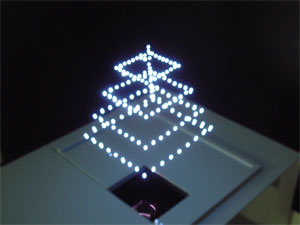
Many previous displays in 3D have been virtual images on 2D planes which, due to human binocular disparity, appear as 3D. However, the limitation of our visual field and the physical discomfort caused by wrongly identifying virtual images makes these displays less than perfect.

The new device uses the plasma emission phenomenon near the focal point of focused laser light. By controlling the position of the focal point in the direction of the x-, y-, and z-axes, real 3D-images in air (3D-space) can be displayed.


This should be very useful for studying 3D shapes the easy way. It's also useful for studying starmaps in StarWars-style. ;)

AddThis Social Bookmark Button

Nanotubes Assemble Themselves Instantly

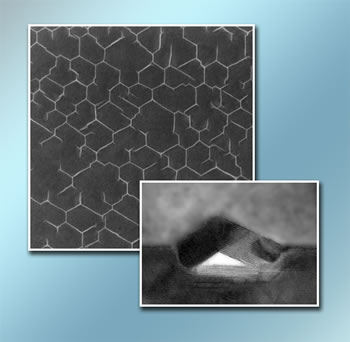
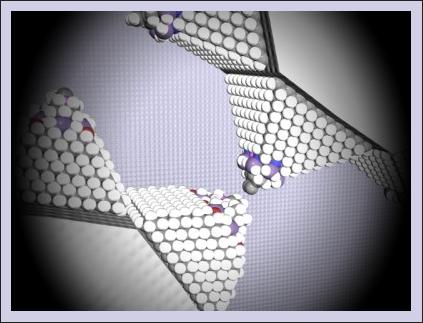
Researchers of the Christian Albrechts University of Kiel have found a new way of making nanotubes self-assemble:

The new method causes extensive hexagonal networks of tubes, intricately branched and connected, to form in less than a second on the surface of a layered crystal. The tubes themselves are prismatic folds, having the cross section of a pitched roof.

...

Surface nanotube networks suggest numerous applications, including networks of pipes for the storage and transport of minute quantities of materials, or templates for the fabrication of nanowire networks.


The ability to make detailed nanotube networking is important if science wants to build fullblown nanocomputers. As you can see, we're getting there.

AddThis Social Bookmark Button