Sunday, April 16, 2006

Nanoscience Rising Up To Meet Energy Challenge

Nanoscience Rising Up To Meet Energy Challenge.

Tiny materials may bring about large-scale advances in a future hydrogen economy, Institute Professor Mildred S. Dresselhaus told audiences Wednesday, April 5, at MIT and at the Technion Israel Institute of Technology.

...

While hydrogen has advantages, it's "not a fuel. You can't mine it. We would have to make nine million tons a year, and eventually, 20 times more than that," Dresselhaus said. Because hydrogen is currently produced from fossil fuels, scientists would have to find a way to produce it from sustainable sources such as rainfall and ocean water.

"We need to develop the technology to convert hydrogen and water to free hydrogen, but we don't know how to do it cheaply and at a large scale," she said.

To make hydrogen that works as well as gasoline as an automotive fuel or to power the fuel cells that may replace internal combustion engines, researchers are depending on nanotechnology.

"By using new advanced materials now becoming available through nanoscience, scientists can take advantage of quantum phenomena that occur at this scale," she said.

Nanotechnology can help develop efficient, inexpensive catalysts for hydrogen production and storage. Several chemical species contain hydrogen in high concentrations, but the trick is to release hydrogen from its strong chemical bonds to make it usable in a system like a car that needs a steady flow of fuel.

Also see New Advances Made in Hydrogen Fuel Cells.
The best hope for bringing the hydrogen-fueled automobile to the American roadway may be a technology that is invisible to the naked eye.

The technology is in the form of tiny graphite structures that together act as a sponge to absorb and store hydrogen in the fuel system of the automobile. Onboard storage of hydrogen gas is the major obstacle impeding the progress and wide-scale commercial production of the hydrogen-powered vehicle, which many view as the next generation in energy-efficient and environmentally friendly road transportation.

The graphite structures are a product of the burgeoning field of nanotechnology. Engineers design the structures at the molecular level, working in scales as small as millimeters and nanometers. The engineers stack the fibrous platelets one atop the other, leaving the optimum gap between the wafers; then they arrange the chemistry so that hydrogen molecules are absorbed in the graphite.

The nanostructures are extremely porous, like a sponge, allowing them to absorb large capacities of hydrogen until fully saturated. Experiments demonstrate that the hydrogen storage in graphite nanofibers is safe.

Another method of hydrogen storage derived from nanotechnology involves carbon nano-tubes. With carbon nanotubes, engineers arrange carbon platelets in different configurations. Research has shown the carbon nanotubes to display strong hydrogen storage capabilities.

AddThis Social Bookmark Button

Thursday, April 13, 2006

Nanopore Method Could Revolutionize DNA Sequencing

Nanopore Method Could Revolutionize Genome Sequencing.

A team led by physicists at the University of California, San Diego has shown the feasibility of a fast, inexpensive technique to sequence DNA as it passes through tiny pores. The advance brings personalized, genome-based medicine closer to reality.

The paper, published in the April issue of the journal Nano Letters , describes a method to sequence a human genome in a matter of hours at a potentially low cost, by measuring the electrical perturbations generated by a single strand of DNA as it passes through a pore more than a thousand times smaller than the diameter of a human hair. Because sequencing a person's genome would take several months and millions of dollars with current DNA sequencing technology, the researchers say that the new method has the potential to usher in a revolution in medicine.

...

The researchers caution that there are still hurdles to overcome because no one has yet made a nanopore with the required configuration of electrodes, but they think it is only a matter of time before someone successfully assembles the device. The nanopore and the electrodes have been made separately, and although it is technically challenging to bring them together, the field is advancing so rapidly that they think it should be possible in the near future.

In addition to the speed and low cost of the nanopore method, the researchers calculate that it will ultimately be significantly less error-prone than current methods.

DNA moving through a nanopore (click to enlarge)


Personalized medication will be far more effective than our current 'one-size-fits-all' type of drugs. In reality, one size doesn't fit all.

AddThis Social Bookmark Button

Brain Computer Interface Commercially Viable

Brain Computer Interface Commercially Viable.

A non-invasive device that allows severely paralysed people to interact with a computer via their brain signals has been improved to make it a viable commercial product by Cambridge Consultants (CCL).

Known as a brain-computer interface (BCI), the device uses electroencephalography (EEG) to detect microvolt brain signals, then applies an adaptive algorithm that focuses on the EEG features the person is best able to control.

Those signals can be mapped onto functions for tasks such as manoeuvring a cursor around a PC screen, or for spelling out words for a speech synthesiser.

The system, developed by researchers at the Wadsworth Center, a New York State health unit, originally used a large, $13,000 64-channel amp and the user had to wear a bulky cap to apply 64 electrodes to the skull.

CCL’s input involved reducing the size, complexity and cost to make it more suitable for home or hospital use.

...

The cost of the enhanced system has been reduced to $5,000, the amount users can claim from Medicare for a speech-assist device.

Right now, usage of these types of systems is limited to paralysed people. But inventions that were originally made for the ill, have a tendency of ending up being used by other people as well (example: bubblebaths; originally invented for people with backaches).

In the future, our computers will be able to read our minds. We'll be giving it commands by thinking about them.

That should make for an interesting videogame experience. ;)

AddThis Social Bookmark Button

Robot Uses Solar Power For 500km Trek

Robot Uses Solar Power For 500km Trek.

The Cool Robot is a solar-powered four-wheel-drive autonomous science vehicle designed for summer use in the Antarctica and Greenland.

Developed in New Hampshire by the US Army’s Cold Regions Research and Engineering Laboratory, together with the state’s Dartmouth College, it weighs 61kg and measures 1.2x1.2x1.0m.

Providing the summer sun is above 16°C, Cool Robot can drive on soft snow entirely powered by its solar cells at a speed of 0.78m/s where consumption averages to 160W.

Estimates based on these figures, obtained from testing in Greenland last year, suggest that over two weeks it will be able to carry a 15kg payload 500km across the Arctic plateau.

AddThis Social Bookmark Button

Wednesday, April 12, 2006

Getting Evolution Up To Speed

Getting Evolution Up To Speed.

New evidence suggests humans are evolving more rapidly -- and more recently -- than most people thought possible. But for some radical evolutionists, Homo sapiens isn't morphing quickly enough.

...

Some radical thinkers suggest human evolution needs to move even faster, with a little help from science.

"Biological evolution is too slow for the human species," said Ray Kurzweil, futurist and author of The Singularity Is Near. "Over the next few decades, it's going to be left in the dust."

...

Trans-humanist pundit James Hughes, author of Citizen Cyborg, thinks it's time to speed up the evolutionary process.

"You can take what nature gave you, but there's no good reason to take nature as a guide for where you should go in the future," Hughes said.

"People are comforted by the slow pace of biological evolution," said Kurzweil. He predicted that "genetic reprogramming" will soon lead to "dramatic evolutionary changes."

The biotech era is slated for the 2010-2020 timeframe. In that decade, we will likely use drugs to mimic a genetic modification and see how we like the results. Cutting edge technologies such as RNA Interference will help in making that come to pass.

If the mimicked modification works out well, many of us will probably choose to make the genetic modification permanent.

By modifying our genetics, we can solve such things as obesity and baldness. It can be used to make us predisposed to growing muscle tissue. And with any luck, we could all get the genetics to digest anything extremely well, rendering us less susceptible to the negative side effects of things we like to eat and drink.

We could even become super-regenerative.

Our health, our looks and the overall quality of our lives are likely to increase a great deal in the coming years because of gene-mod technology.

AddThis Social Bookmark Button

Stem Cells Used To Regrow Broken Bone

Stem Cell Therapy A World First.

A Melbourne man is the first person in the world whose own stem cells are being used to try to mend a broken leg.

The cutting-edge stem-cell technology has helped Jamie Stevens, 21, back on his feet.

A motorcycle crash nine months ago left him with a severely broken left thigh bone. Part of the femur stuck through his leg, and other parts of the bone were missing.

The bone failed to heal and Mr Stevens's leg was held together by a large titanium plate.

Royal Melbourne Hospital orthopedics director Richard de Steiger decided Mr Stevens was the ideal first patient for a revolutionary stem-cell trial at the hospital.

About seven weeks ago, Mr de Steiger harvested bone marrow from Mr Stevens' pelvis.

The adult stem cells were then separated from the other cells.

A sub-group of stem cells called mesenchymal precursor cells -- those that can transform into tissues including bone, cartilage and heart -- were isolated and grown.

Last week, about 30 million of these cells were implanted into the 5cm x 3cm hole in Mr Stevens' thigh bone.

The cells were coated on to pieces of calcium phosphate that act as a scaffold for the cells when they are placed inside the bone.

The cells are expected to regenerate new bone and grow through the calcium phosphate.

Yesterday, just four days after surgery, Mr Stevens went home.

AddThis Social Bookmark Button

Cheaper Fuel Cells

Cheaper Fuel Cells.

Fuel cells still cost too much to be a viable alternative for internal combustion engines in cars -- they require expensive materials and are difficult to make. Now [...] a new, simple-to-produce material boosts the performance of fuel cells many times -- and could be a major step toward making them affordable.

...

The researchers say the new membrane conducts protons nearly three times as well as the currently used material, significantly improving power density. Also, unlike the current material, the new membrane can be easily molded into patterns to increase its surface area. By increasing the area by up to 60 percent, the researchers have further doubled the power density of a fuel cell. Joseph DeSimone, the UNC-Chapel Hill chemistry and chemical engineering professor who heads the lab where the work was done, thinks they can increase the membrane's surface area 20 to 40 times by using different patterns, increasing the power density proportionately.

Such improvements in power density mean that a much smaller fuel cell could provide adequate power for a vehicle. The material is also easier to work with, which should reduce manufacturing costs.

AddThis Social Bookmark Button

Building Cyborgs In Real Life

'We can rebuild him. We have the technology.' Almost.

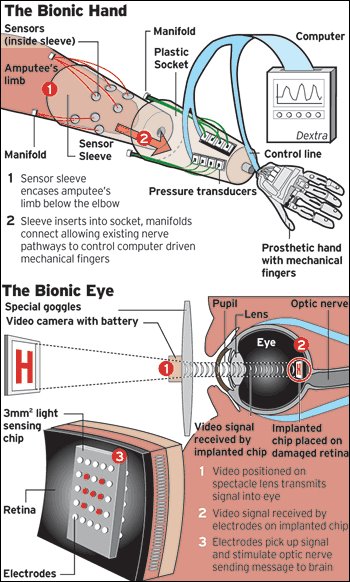
Three decades after the hit television programme The Six Million Dollar Man described how the broken body of a former astronaut was rebuilt with mechanical parts, scientists are closer than ever to creating such cyborgs.

The character Steve Austin, played by Lee Majors, became a 1970s pop culture icon after his legs, right arm and left eye were replaced in an operation that gave the world the catch phrase: "Gentlemen, we can rebuild him. We have the technology."

Yesterday, at the Experimental Biology 2006 meeting attended by around 12,000 delegates in San Francisco, leading scientists explained in a symposium on "The $6 Billion (Hu) Man" how much of what was once fiction is becoming reality - including electronically powered legs, arms and eyes.


It's the same with sixties Star Trek. Much of what was considered extremely hi-tech in that show, is now considered old fashioned.

Funny how things like that can work out.

Anyway... the source article goes in depth about cybernetic legs, arms, hands, eyes and ears.

AddThis Social Bookmark Button

Tuesday, April 11, 2006

The Car That Drives Itself

The Car That Drives Itself.

It’s not KITT, but it’s close: The Honda Accord ADAS can sense its proximity to other cars and objects and steer itself to stay within lane lines. And you thought cruise control was cool.

Video clip at the source. Be sure to check it out.

Also see Driverless Cars Race 130 Miles.

With things going as fast as they are in this area, I have a gut-feeling we can expect our cars to do a lot of driving for us well before 2020.

AddThis Social Bookmark Button

On Regrowing Organs

Regrow Your Own.

Stem cell therapy has long captured the limelight as a way to the goal of regenerative medicine, that of repairing the body with its own natural systems. But a few scientists, working in a relatively obscure field, believe another path to regenerative medicine may be as likely to succeed. The less illustrious approach is promising, in their view, because it is the solution that nature itself has developed for repairing damaged limbs or organs in a wide variety of animals.

Many species, notably amphibians and certain fish, can regenerate a wide variety of their body parts. The salamander can regenerate its limbs, its tail, its upper and lower jaws, the lens and the retina of its eye, and its intestine. The zebra fish will regrow fins, scales, spinal cord and part of its heart.

Mammals, too, can renew damaged parts of their body. All can regenerate the liver. Deer regrow their antlers, some at the rate of 2 centimeters a day, said to be the fastest rate of organ growth in animals. In many of these cases, regeneration begins when the mature cells at the site of a wound start to revert to an immature state. The clump of immature cells, known as a blastema, then regrows the missing part, perhaps by tapping into the embryogenesis program that first formed the animal.

...

There are reports that the tip of the finger can occasionally be regenerated, if the cut is above the last joint. And people can vigorously repair damage to the liver. Even after 75 percent has been removed in surgery, the liver regains its original mass in two to three weeks. It is not certain why other organs and limbs have lost this useful capacity, but perhaps only the liver was damaged often enough during its owner's lifetime to make a repair system worth the cost. "I believe that the reason is the extensive and recurring injury that the liver was exposed to in evolution: rotten food, plant toxins, viruses," says Markus Grompe, a liver expert at the Oregon Health and Science University.

...

Regeneration and stem cell therapy are promising aspects of regenerative medicine but both are still at the research stage. "I'm very bullish on regenerative medicine," said Dr. Keating, alluding to both types. "I think it's going to happen and it will be a revolution, but it will take time. It would be a mistake to oversell it and promise too much too early."

Summary:

Stem cells aren't the only way we might regenerate lost limbs and organs. The body seems to have the capability to regrow much all by itself, it's just that the genes responsible for it are shut off. Future drugs might activate the genes again, thereby giving us back our regenerative capabilities.

Also see the Super Renegerative Mouse.

AddThis Social Bookmark Button

Thursday, April 06, 2006

Bionic Device Allows Woman To See Without Eyes

New Device Allows Woman To See, Even Without Eyes.

More than a million people in the United States are legally blind. Many of them once had vision but tragically lost it. Now a breakthrough device could give them back some of their sight.

...

Robertson is blind, but this device allows her to see, not with her eyes but with her brain! Fifteen years ago, she lost both of her eyes in a car accident. She was just 19 years old.

"When I realized yes, I am going to be blind, I thought, I guess I'm going to learn to do things a little differently now," Robertson says. And she did. She traveled to Portugal to become the 16th person in the world to have special electrodes implanted in her brain. With the help of a device, she could see again!

"I said, ‘Oh my God, I can see it. I can see it,' and I was just so excited!"

Neurosurgeon Kenneth Smith, M.D., of Saint Louis University School of Medicine, said the procedure is the first to reverse blindness in patients without eyes. "They are really seeing. The brain is getting impulses just like when you and I see."

bionic vision

Be sure to check out the movie at the source article.

AddThis Social Bookmark Button

Speedy Walking Robot Developed

Speedy Robot Legs It To Break Record.

A two-legged robot that walks at record-breaking speed has been developed by researchers from Germany and Scotland.

"RunBot" is the fastest robot on two legs – for its size. At 30 centimetres high, it can walk at a speedy 3.5 leg-lengths per second. This beats the previous record holder – MIT's "Spring Flamingo" – which is four times as tall but manages just 1.4 leg-lengths per second.

The robot is controlled by a simple program that mimics the way neurons control reflexes in humans and other animals. Unlike most other two-legged robots, RunBot has few sensors and can detect just two things – when a foot touches the ground, and when a leg swings forward.

"We wanted to show that a very simple system with a simple neuronal controller could walk in a natural manner – and fast," says Florentin Wörgötter, from the University of Göttingen in Germany, who developed RunBot along with researchers at the University of Glasgow and the University of Stirling, both in Scotland.

Two mpeg videos show RunBot walking at a steady speed and gradually learning to walk more rapidly.

AddThis Social Bookmark Button

Tuesday, April 04, 2006

Organs Grown In Lab, Implemented In Humans

On a Scaffold in the Lab, Doctors Build a Bladder.

Bladders created in the laboratory from a patient's own cells and then implanted in seven young people have achieved good long-term results in all of them, a team of researchers reported yesterday in a medical journal.

It takes about two months to grow the new bladder on a scaffold outside the body. After implantation, the engineered bladder enlarges over time in the recipient. The researchers say they expect that the new bladder will last a patient's lifetime, but the longevity will be known only as the children grow older.

The hope is that someday the experimental reconstruction procedure will be standard for larger numbers of patients, including adults, and for those with other kinds of bladder damage.

A major advantage of his technique is that rejection cannot occur because the cells used to create a new bladder are from the patient, not from another individual. So an ultimate aim — still years off — is to develop the technique to grow a wide variety of other tissues, possibly even organs, to help relieve the shortage of donor organs available for transplanting, said the research team's leader, Dr. Anthony Atala. He directs the Institute for Regenerative Medicine at Wake Forest University Baptist Medical Center in Winston-Salem, N.C.

Not only useful for replacing organs, but also for total body rejuvenation.

Imagine a future where we could replenesh our aging bodies with younger cells. This would mean a gigantic boost for human health and longevity.


[update]

Here is an article (Adobe Acrobat Reader required and freely available) that covers this in more detail.

AddThis Social Bookmark Button

10 Medical Breakthroughs To Watch Out For In The Next 10 Years

10 Medical Breakthroughs to Watch for in the Next 10 Years.

In the last decade, scientists have mapped the human genome, begun to unlock the secrets of stem cells and made strides in battling diseases with treatments that were the stuff of science fiction not long ago.

What about the decade to come?

"The current state of medicine is too 'one-size-fits-all,' " said William Moffitt, chief executive officer of the Northbrook- based biotechnology company Nanosphere Inc. "The future of medicine is to treat diseases on an individualized level, to personalize the treatment," Moffitt said.

That's the sphere of nanotechnology, the science of engineering applications at the molecular level. "Nanotechnology will start from the other end of the spectrum, because if you want to treat a disease on the genetic or molecular level, you need tools that are small and precise enough to do that for you."

Exactly. And we're getting closer to sophisticated nanotech tools with every passing day.

The 10 medical breakthroughs forecasted by this article:
  1. Cancer
  2. Obesity
  3. Heart disease
  4. Avian flue
  5. Mental disease
  6. Alzheimer's disease
  7. Paralysis
  8. Laser technology (for accurately diagnosing and destroying tumors)
  9. Pregnancy screening
  10. Public health

AddThis Social Bookmark Button

Home Robots To Be Pushed Into The Mainstream

In a Wired South Korea, Robots Will Feel Right at Home.

SEOUL, South Korea — South Korea, the world's most wired country, is rushing to turn what sounds like science fiction into everyday life. The government, which succeeded in getting broadband Internet into 72 percent of all households in the last half decade, has marshaled an army of scientists and business leaders to make robots full members of society.

By 2007, networked robots that, say, relay messages to parents, teach children English and sing and dance for them when they are bored, are scheduled to enter mass production. Outside the home, they are expected to guide customers at post offices or patrol public areas, searching for intruders and transmitting images to monitoring centers.

If all goes according to plan, robots will be in every South Korean household between 2015 and 2020. That is the prediction, at least, of the Ministry of Information and Communication, which has grouped more than 30 companies, as well as 1,000 scientists from universities and research institutes, under its wing. Some want to move even faster.

"My personal goal is to put a robot in every home by 2010," said Oh Sang Rok, manager of the ministry's intelligent service robot project.

What are the implications of this?

AddThis Social Bookmark Button

Monday, April 03, 2006

Rapid Nano Molding

Rapid Nano Molding.

Researchers are using a new all-purpose nano synthesis method to design cancer-fighting nanoparticles.


A highly versatile method for making nanoparticles has now been used to make multipurpose cancer treatment particles. According to Joseph DeSimone, chemistry and chemical engineering professor at the University of North Carolina at Chapel Hill and North Carolina State University, who presented the work at the American Chemical Society conference this week in Atlanta, the new synthesis method has potential applications in fuel cells, microfluidics, and vaccines as well.

The process has the "ability to create nanoparticles of nearly any shape or chemical composition. It is very, very promising," says Shelton Earp, director of the Lineberger Comprehensive Cancer Center at UNC. Experts at the cancer center are now starting live animal tests of nanoparticles that were made using the method. The particles are designed to slip out of the bloodstream and deliver both drugs and imaging agents directly to cancer cells, sparing healthy cells. Such targeted delivery could significantly improve both the safety and effectiveness of cancer drugs. Earp says that within a year, separate studies will show whether particles made this way can safely and effectively combat skin and breast cancer in mice.

AddThis Social Bookmark Button

The Fountain Of Health

TechnologyReview has an article on current trends in anti aging research. The article touches on the familiar topic of caloric restriction, the consequences thereof and other things.

What caught my eye, however, was this:

Up until a decade or so ago, most biologists believed that the aging process was not only immensely complex but also inevitable. People aged, they assumed, much the way an old car does: eventually, everything just falls apart. Then in the early 1990s, Cynthia Kenyon, a young molecular biologist at the University of California, San Francisco, found that mutating a single gene, called daf-2, in worms doubled their life spans. Before the discovery, says Kenyon, "everyone thought aging just happened. To control aging, you had to fix everything, so it was impossible." Kenyon's research suggested a compelling alternative: that a relatively simple genetic network controlled the rate of aging.

The race to find the genetic fountain of youth was on. Within a few years, Leonard Guarente, a biologist at MIT, found that in yeast, another gene produced a similar dramatic increase in life span. Soon after, Guarente and his MIT coworkers made another startling discovery: the yeast antiaging gene, called sir2, required for its activity a common molecule that is involved in numerous metabolic reactions. Guarente, it seemed, had found a possible connection between an antiaging gene and diet. The gene, Guarente thought, might be responsible for the health benefits of calorie restriction; and indeed, the lab soon confirmed that calorie restriction in yeast had life-extending effects only when sir2 was present.

Not too long ago, in the mid ninetees, my own biology teacher at the time explained to us that the reason why we age is wear and tear. Now, it is becoming more and more clear that the aging process is a programmed process, and that it can be tweaked to our advantage.

Curing aging is not the gargantuan and impossible task that some uninformed people would have you believed. It's way simpler than that. Still a big task, but nowhere even close to impossible.

Also see The Quest For Immortality.

AddThis Social Bookmark Button

Sunday, April 02, 2006

Nanonutrient's Promise: Vast Increases In Human Health

Nanonutrient's Promise: Vast Increases In Human Health

Newswise — The emerging discipline of nanotechnology holds the promise of improving functional foods and the capability of delivering healthful food compounds to the body where it can utilize them best. This is according to the latest issue of Food Technology magazine.

Remarkable achievements in nanotechnology—the science, engineering and technology of controlling matter one-billionth a meter in size—show great potential for positively influencing human health, the article states. By enhancing solubility, improving bioavailability, and facilitating the controlled release and protecting the stability of micronutrients in food products, nanotechnology could be a successful method to design smart food systems able to target specific systems within the body and their functions.

...

The article notes that nanoparticles are excellent for rapidly delivering high concentrations of healthy, active ingredients directly to cell membranes. On the other hand, the article highlights that nanoscale adhesive properties may be used to bind to harmful matter and remove potentially harmful compounds from the digestive tract.

Another interesting article (and videoclip) on nanofood can be found on ScienCentral.
Everyday foods may soon be able to carry medicines and supplements, or even take on your favorite color. As this ScienCentral News video explains, physicists are using nanotechnology to create tiny edible capsules that release their contents on demand.

...

Nanotechnologists are working on adding ingredients that could one day "program" the contents of your cupboard, at a moment's notice, filling your pantry with, "Functional foods… to enhance its health value, its taste, its smell, its general quality," explains Harvard University David Weitz. Using the same technique they might even make taking your medicines as easy eating a candy bar.

But, many Americans associate the phrase "artificial ingredients" with unhealthy eating habits, so Weitz's work might turn that notion upside down. "If you drink a milkshake, you look at it and worry that you're going to gain weight because it tastes so good. You might imagine something that would limit the ability of the body to absorb all the fat, or add a nutrient or enzyme that would improve the benefits of the milkshake so you wouldn't worry about the weight you are about to gain by drinking the tasty milkshake," he says.

I personally am looking forward to this. Even though I eat and exercise healthy, I have suffered from minor health problems in the past and still do now. It's nothing that has ever gotten in the way of living life to the fullest, but I'd still like to get rid of them anyway. Just so I could feel healthier than I do now.

It is my experience that eating healthy and exercising solves a lot, but not everything. In order to cure some things, you need supplements and medication. Simply because a standard healthy diet of fruit and veggies doesn't cut it.

Nano-engineered food that has extra supplements, medications or other particles that counter the negative effects and enhance the positive effects of what you eat, would be very welcome in my life. And I'm guessing that goes for a lot of other people as well, even though they don't realize it themselves.

Also, I hate the taste of vegetables. I stuff them down my face 6 days a week, because I know my body needs them. Nevertheless, I regard vegetables as rabbit food. And that's the last thing I want to come home to after an 8 hour day of work.

My life would sure be a lot easier if vegetables could be nano-engineered to taste like french fries.

The term nanofood is already popular on the web. Several sources tell me it's only a few years away from becoming mainstream. Hey, sounds good to me. Not only will it improve the quality of our lives, it will also do wonders for the reputation of nanotechnology in the eyes of the public.

AddThis Social Bookmark Button

Nano Welding Could Join Molecular Devices

Nano Welding Could Join Molecular Devices

A nanoscale welding technique has been developed by sparking high-temperature chemical reactions inside "nanopores".

The technique could ultimately be used to weld together nanoscale components and could also lend itself to nanoscopic chemistry experiments, say the researchers.

...

Richter says nanoscale thermite reactions could perhaps be used to "weld" together molecular machines. But the real value of the technique could be more wide-ranging, he believes. The holes filled with iron oxide could be used as nano-receptacles for other chemicals, giving chemists finer control of chemical reactions, he says.

"This is something we couldn't do before - chemists have to rely on random processes to bring reactants together," Richter told New Scientist. "Being able to impose order on such a small scale could make a big difference."

For example, Richter suggests the technique might be used in manufacturing metal compounds. "The strength of alloys depends on how many flaws they have, and the technique we developed could allow very ordered arrangement of different compounds to make sure no flaws form," he says.

AddThis Social Bookmark Button

Scientists Demonstrate Quantum Nature Of Entanglement Swapping

Scientists Demonstrate Quantum Nature Of Entanglement Swapping.

As if plain old quantum entanglement weren’t strange enough for modern physics, now physicists are entangling already entangled particles. In entanglement swapping, one particle of an entangled pair becomes entangled with a third particle, which itself becomes entangled with the other particle in the first pair, even though the two never interact. Here’s how physicists are unraveling this behavior and manipulating it for use in quantum communications and high-speed computing.

Even as today’s most powerful supercomputers can send information at ever increasing speeds, scientists predict that quantum computers will operate millions of times faster. With the help of entangled photons, which instantaneously correlate with one another even when separated by large distances, scientists are developing a process called quantum teleportation. Currently, however, physicists can only teleport information a hundred or so miles before signal loss weakens the connection.

...

With a quantum repeater – containing an independent, synchronized photon source – located at periodic locations along the channel, a computational signal will receive a power boost, enabling it to continue toward its destination. In a sense, entanglement swapping is a bit like fueling your car at a gas station – but you can skip all the driving in between.

AddThis Social Bookmark Button